Examining the effect of neighborhood sanitation coverage on childhood diarrheal disease in rural Bangladesh

Feb 18, 2026

Recent MCIDT Trainee graduate Hannah Van Wyk and affiliates Andrew Brouwer and Joseph Eisenberg developed the spatially informed Neighborhood Sanitation & Fecal Exposure metric and found a positive association with childhood diarrheal prevalence.

Key Terms: Sanitation coverage; WASH; Fecal contamination; Diarrheal disease
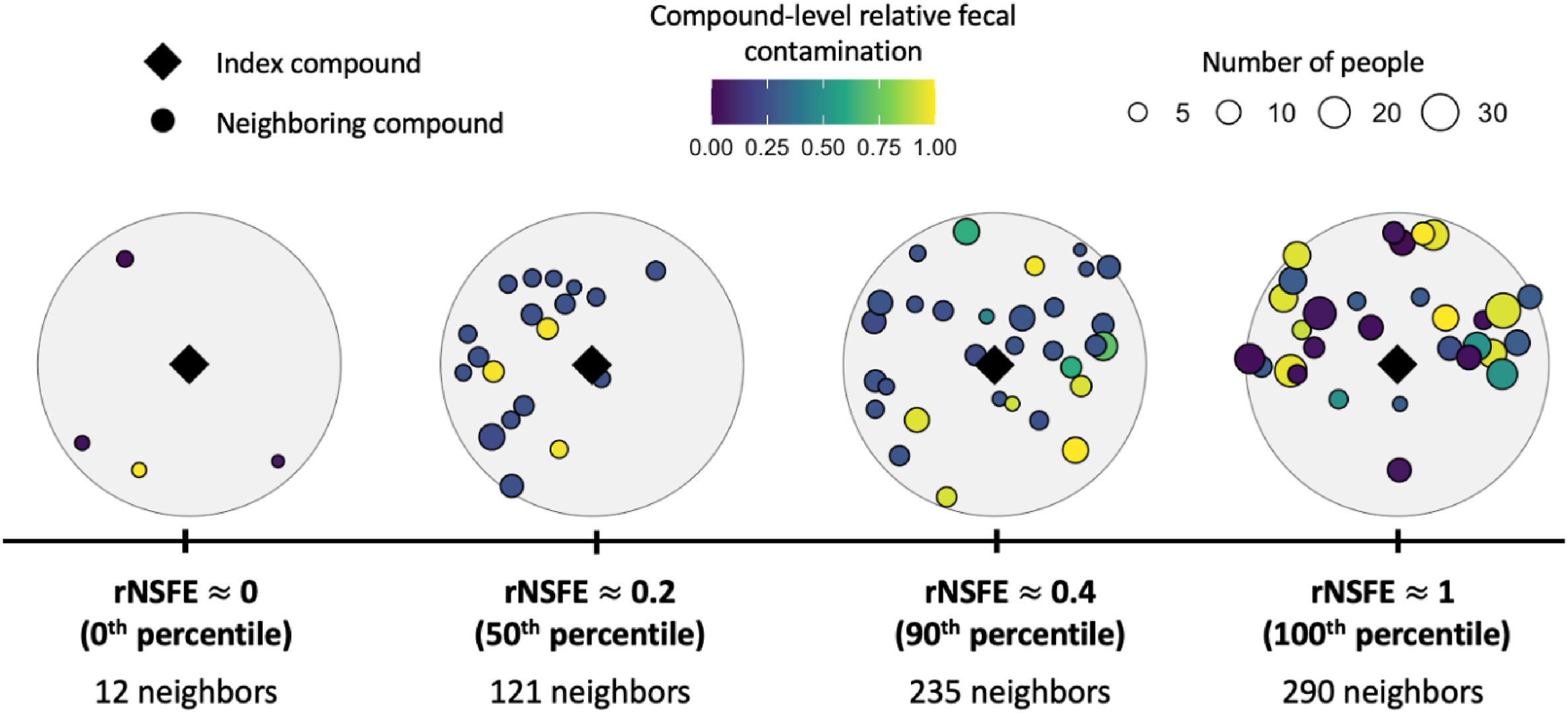
Fig. 2. Four study compounds (diamonds) and all neighboring compounds within 100 m (circles) representative of the relative Neighborhood Sanitation & Fecal Exposure (rNSFE) values of approximately 0 (the lowest possible value), 0.2 (50th percentile), 0.4 (90th percentile), and 1 (the highest possible value). The size of the circles denotes the number of people living in each neighboring compound. Neighboring compounds are colored by the fecal exposure (i.e., contamination level) with yellow representing higher fecal contamination, and dark purple lower. (For interpretation of the references to color in this figure legend, the reader is referred to the Web version of this article.)